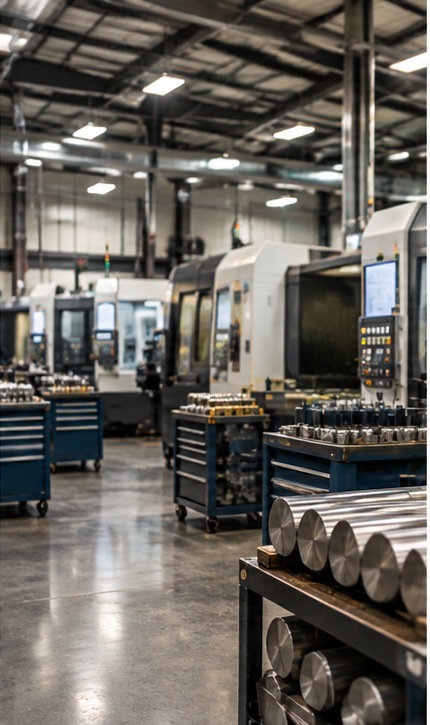
Precision suppressor manufacturing involves more than producing a metal component that looks correct. It depends on consistent machining processes, clear specifications, reliable measurements, and the ability to reproduce acceptable parts throughout a production run.
The company’s Bloomington location connects its manufacturing operations to Indiana’s broader industrial economy. Learn more about the regional context in our article on Barrelistics as a suppressor manufacturer in Indiana.
At Barrelistics in Bloomington, Indiana, precision manufacturing is central to the company’s identity. Barrelistics describes a background built on decades of high-volume machining experience, supported by CNC turning, Swiss-style turning, and production practices focused on consistency.
For anyone evaluating a manufacturer, understanding these processes provides useful context. Equipment itself tells only part of the story. How a business manages manufacturing variation, communicates technical requirements, and documents its work matters just as much.
Here are seven established manufacturing practices that help explain the principles behind precision suppressor manufacturing and the approach Barrelistics brings to its products.
1. Precision Suppressor Manufacturing Starts With Clear Specifications
Before manufacturing begins, a component needs a defined set of requirements.
In precision machining, technical drawings and documented specifications establish the characteristics that production must achieve. These may include dimensions, material requirements, and the condition of finished surfaces.
Without clear specifications, consistency becomes difficult to measure.
A finished component may look acceptable to the naked eye while differing from its intended dimensions. Small variations are not always visible, especially when dealing with precision-machined metal parts.
Why Manufacturing Tolerances Matter
A tolerance defines the acceptable variation in a measured characteristic.
In industrial production, tolerances are selected based on the functional requirements of a component. They are not universal measurements of quality.
One feature may require relatively close dimensional control, while another can accommodate a wider range without affecting its intended purpose.
Successful manufacturing involves understanding those differences and producing components within their specified limits.
For precision suppressor manufacturing, this broader principle is relevant because the finished product depends on components manufactured to defined requirements.
Barrelistics emphasizes tight-tolerance manufacturing as part of its production background. Individual product specifications remain the appropriate source for determining what requirements apply to a particular model.
2. CNC Machining Supports Consistent Production
Computer numerical control, commonly known as CNC, has become a fundamental technology in modern precision manufacturing.
CNC machines use programmed instructions to control machining operations. These instructions help reproduce defined features consistently when the equipment is properly configured and maintained.
For a manufacturer working with precision-turned metal components, CNC technology can support repeatable production.
However, a programmed machine does not eliminate the need for skilled employees or process oversight.
CNC Machining Still Requires Manufacturing Expertise
Machine setup, material characteristics, cutting tools, maintenance, and inspection all influence the final result.
A machine may follow the same programmed movement repeatedly, but that does not automatically guarantee identical finished components.
Cutting tools wear during use. Materials may behave differently between batches. Temperature and machine condition can also influence dimensional results.
Experienced manufacturing teams account for these variables as part of normal production management.
This is why precision suppressor manufacturing should be evaluated through the complete manufacturing process rather than the presence of CNC equipment alone.
Barrelistics identifies advanced CNC turning among its manufacturing capabilities.
The company describes its production philosophy as focused on consistency, repeatability, and processes suitable for ongoing manufacturing.
The Difference Between One Good Part and Consistent Production
Producing a single component that meets its specification is an achievement.
Repeating that result over a larger production run presents a different challenge.
A manufacturing process must remain stable as equipment operates, tools wear, and production conditions change.
The goal is to make acceptable results repeatable rather than depend on extensive individual adjustments.
That distinction is particularly relevant to businesses with experience in high-volume manufacturing, including the background Barrelistics describes.
3. Swiss-Style Turning Adds Specialized Manufacturing Capabilities
Swiss-style turning is another manufacturing technology associated with high-precision metal components.
This type of machining is commonly used for relatively small or slender turned parts, particularly where controlling the workpiece during machining is important.
Swiss-style equipment supports the material close to the cutting area, helping manufacturers manage certain dimensional challenges associated with these components.
Not every precision-machined part requires Swiss-style turning. Different component designs and production requirements call for different manufacturing approaches.
Why Manufacturing Capabilities Should Match the Application
A capable manufacturer selects production methods according to the characteristics of the work being performed.
No single machine architecture is the ideal solution for every component.
Conventional CNC turning, Swiss-style turning, and other manufacturing processes each have applications where their particular characteristics may be useful.
Understanding these distinctions is a sign of manufacturing experience.
For Barrelistics, Swiss-style turning forms part of the company’s published manufacturing background.
Within precision suppressor manufacturing, that experience contributes to the broader discussion of process selection, dimensional consistency, and production planning.
Customers do not need to understand every machining operation to appreciate why these capabilities matter.
What they should expect is accurate information about the manufacturer’s experience and clearly documented product characteristics.
4. Inspection and Measurement Are Essential to Precision Suppressor Manufacturing
A manufacturer cannot determine dimensional accuracy from photographs alone.
Measurement provides a way to compare a finished component with its defined requirements.
In precision manufacturing, inspection may occur at different stages of production depending on the component, the manufacturing process, and the applicable quality procedures.
Some measurements help establish whether a process remains stable. Others help confirm whether the finished work meets its specifications.
Understanding Manufacturing Metrology
Metrology is the science of measurement.
Within manufacturing, it includes the methods used to obtain reliable measurements and interpret the results.
Measurement equipment must be appropriate for the feature being evaluated. The conditions under which a measurement is taken can also matter.
An isolated number is useful only when its meaning is understood.
A measurement needs to be connected to a specific feature, an applicable requirement, and a reliable method of evaluation.
The National Institute of Standards and Technology’s machining research provides additional information about machining performance, measurement, and industrial process monitoring.
NIST’s research supports the broader manufacturing industry’s understanding of these subjects. It does not represent an endorsement or certification of Barrelistics products.
Inspection Is About Making Informed Decisions
In precision suppressor manufacturing, inspection principles are relevant because production teams need dependable information about the components they manufacture.
When measurements reveal an unexpected variation, the manufacturing process may need to be evaluated.
The value of inspection lies in helping manufacturers recognize problems and make informed decisions.
Barrelistics describes a production approach focused on disciplined, repeatable manufacturing.
These principles are important to discuss, although customers should distinguish general manufacturing capabilities from product-specific test results or third-party certifications.
5. Repeatability Helps Maintain Quality Across Production Runs
One of the most demanding aspects of industrial manufacturing is producing consistent results over time.
A prototype and a production component may share the same intended design, but the manufacturing challenges are different.
A prototype is often created to evaluate an idea or demonstrate a design.
Production requires a process capable of reproducing the intended component consistently.
That involves planning, inspection, materials management, equipment availability, and ongoing process control.
Why Production Scale Changes the Challenge
Manufacturing larger quantities introduces operational demands that may not be obvious during a small development run.
Tools need maintenance. Materials must be available. Production schedules require coordination.
Finished components must continue to meet the appropriate requirements even when work is repeated over extended periods.
A company experienced in high-volume machining develops its approach around these recurring production challenges.
Barrelistics places that type of experience at the center of its manufacturing identity.
For readers researching precision suppressor manufacturing, the important distinction is between having access to machinery and having experience managing repeatable production.
Barrelistics brings years of precision machining experience to its manufacturing approach. To learn more about the company’s background, Bloomington location, and production philosophy, explore our introduction to Barrelistics.
Consistency Is Not the Same as Perfection
No responsible manufacturer should claim that every production variable can be eliminated.
Even sophisticated manufacturing processes operate within measurable limits.
The objective is to understand those limits and maintain acceptable results through controlled production methods.
Consistent production depends on appropriate specifications, monitoring, inspection, and corrective action when necessary.
That is a more meaningful definition of manufacturing discipline than describing a product as flawless or perfect.
6. Material Selection and Surface Finishing Require Careful Evaluation
The appearance of a finished metal component can provide clues about how it was manufactured, but it does not establish all its technical characteristics.
Different materials have different physical properties.
Density, corrosion resistance, thermal behavior, and other characteristics influence how materials are selected for industrial applications.
Manufacturing processes must account for the properties of the materials being used.
What Surface Finishes Can and Cannot Tell You
A machined surface may show visible tool marks or a uniform finish.
Additional finishing processes can alter appearance and surface characteristics.
However, the visual appearance of a component does not prove that it meets a particular dimensional requirement.
A smooth surface is not automatically more accurate than one with visible machining marks.
Likewise, an attractive product photograph cannot demonstrate long-term durability or measured product performance.
These conclusions require appropriate specifications and evidence.
Why Material Claims Should Be Specific
Precision suppressor manufacturing involves components whose finished characteristics depend on the interaction between design requirements, materials, and production methods.
It is misleading to suggest that a material alone determines the quality of a finished product.
Different materials may be appropriate for different applications, and performance must be evaluated within the intended operating conditions.
Barrelistics offers products with different material configurations.
The company’s catalog provides a starting point for researching available models, while product-specific documentation should be used to evaluate their published characteristics.
Visitors interested in the current lineup can explore the Barrelistics product catalog.
7. Manufacturing Documentation Builds Long-Term Trust
Customers rarely see every stage of a product’s manufacturing process.
They rely on the information available from the manufacturer to understand what the company produces and how it describes its capabilities.
Clear documentation helps bridge that gap.
Technical descriptions, appropriate photographs, product specifications, and consistent company information all contribute to a more transparent manufacturing identity.
Real Manufacturing Evidence Matters
Photographs of production equipment and completed components can help explain a manufacturer’s operations.
However, images should be identified accurately.
A generic photograph of a CNC machine should not be presented as a picture of a particular company’s facility unless it genuinely depicts that location.
The same principle applies to inspection claims, product performance, and certifications.
Manufacturers should distinguish between capabilities they describe, results they have documented, and claims supported by independent testing.
These distinctions are especially useful in a specialized industry where customers may be researching an unfamiliar company.
Manufacturing capabilities are more meaningful when companies communicate them accurately. Our guide to suppressor manufacturer transparency explains how verifiable company information, clear product specifications, and responsible communication help build customer confidence.
Connecting Manufacturing Experience to the Barrelistics Brand
Barrelistics is based in Bloomington, Indiana, and describes a manufacturing background built on decades of high-volume precision machining experience.
That experience predates the current consumer-facing brand.
The company’s public information emphasizes disciplined manufacturing, repeatability, and processes suitable for ongoing production.
For precision suppressor manufacturing, these characteristics provide a foundation for explaining the manufacturing philosophy behind the business.
Visitors can read more about the company’s background on the About Barrelistics page.
The next step in building long-term trust is maintaining accurate technical information and providing clear answers when customers have questions about specific products.
Why Precision Suppressor Manufacturing Matters
Precision manufacturing is a combination of equipment, experience, process control, and measurement.
Each contributes something different.
CNC technology enables programmed machining operations. Swiss-style turning supports particular types of precision work. Inspection helps determine whether components meet their requirements.
Production experience connects those elements into repeatable operations.
For Barrelistics, the manufacturing background behind the brand is a central part of its identity.
The company presents itself as a manufacturer of suppressors and precision firearm components, with an emphasis on consistency and production-ready processes.
Understanding precision suppressor manufacturing helps customers evaluate those claims in their proper context.
Manufacturing capability is not a substitute for individual product specifications or performance testing. It is the foundation on which a manufacturer develops its production methods.
That distinction matters to anyone looking beyond product photography to understand how a company approaches its work.
Beyond manufacturing, Barrelistics operates within an industry connected to recreational shooting and outdoor activities. Our guide to the Indiana shooting sports community explores public ranges, safety practices, and the recreational culture surrounding the company’s home state.
Precision Suppressor Manufacturing in Bloomington, Indiana
Barrelistics operates from Bloomington, Indiana, with a manufacturing-focused approach to precision metal components.
Its background in high-volume machining and its published production capabilities give customers and industry professionals a starting point for learning about the company.
The most useful questions concern the manufacturer’s methods, documentation, and ability to communicate accurately about its products.
For readers evaluating precision suppressor manufacturing, the value of technical content comes from understanding what a process can demonstrate and recognizing where product-specific evidence is still necessary.
Barrelistics continues to develop its brand around those manufacturing principles.
To learn more about its operations and published product information, visit the Barrelistics contact page.
Frequently Asked Questions About Precision Suppressor Manufacturing
What is precision suppressor manufacturing?
Precision suppressor manufacturing involves producing components according to defined specifications using controlled manufacturing processes and appropriate measurement practices. The objective is consistent output that meets the relevant requirements.
Does CNC machining guarantee better quality?
No. CNC machining provides programmed control over machine operations, but finished quality also depends on tooling, materials, setup, inspection, and process management.
What is Swiss-style turning used for?
Swiss-style turning is commonly used for precision machining of relatively small or slender metal components. Its suitability depends on the characteristics and requirements of the work.
Why is inspection important in suppressor manufacturing?
Inspection helps manufacturers evaluate whether components meet defined requirements. It also provides information used to identify manufacturing variation and monitor production processes.
Is Barrelistics a precision manufacturing company?
Yes. Barrelistics describes itself as a manufacturing-driven brand based in Bloomington, Indiana, with experience in high-volume precision machining.
Does precision machining prove a suppressor’s acoustic performance?
No. Precision machining describes manufacturing capabilities and processes. Acoustic performance requires appropriate product-specific testing and cannot be established from machining equipment or surface appearance alone.